
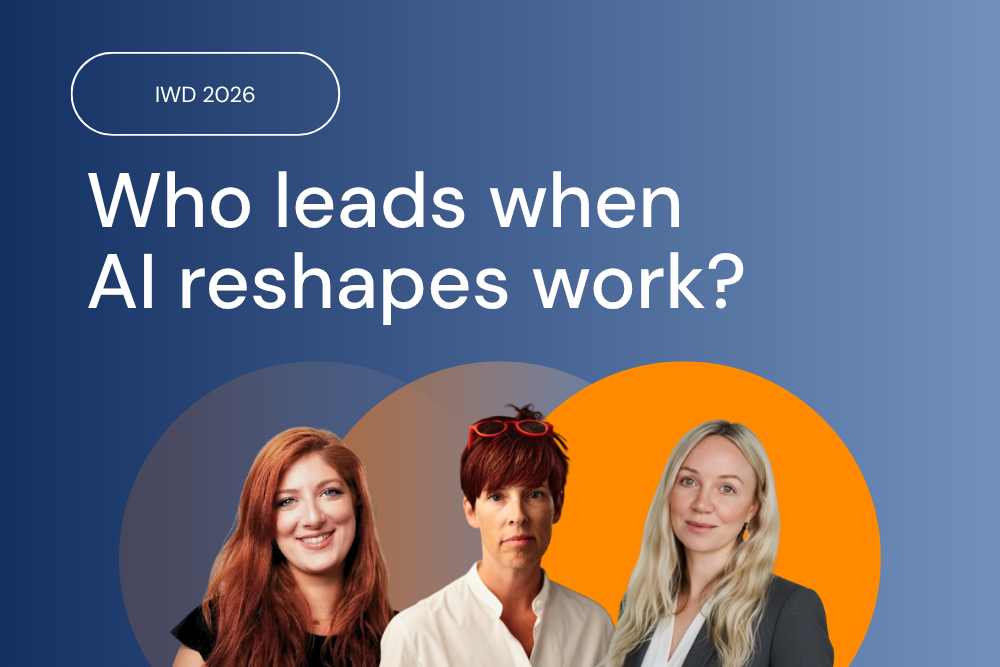
To mark International Women’s Day 2026, we hosted a LinkedIn Live discussion exploring the intersection of AI, leadership, capability and organisational design.
Moderated by Julia Barber, Director at Renovata, the panel brought together Catherine Alani, Chief Operating Officer at Jigsaw, Caroline Gorski, Co-founder of Cerestrial LLP Group, and Natalie Seatter, Chief Data & AI Officer at HBX Group.
Beyond Productivity: A Shift in Power
While much of the AI narrative continues to focus on productivity gains, the discussion highlighted a deeper and more consequential shift taking place within organisations: the reallocation of power.
Rather than purely transforming efficiency, AI is reshaping how decisions are made, who holds influence, and how leadership is exercised. This shift is often subtle, but increasingly visible in how organisations behave and how leaders respond to uncertainty
Leadership Under Pressure: Certainty vs. Curiosity
A recurring theme was the pressure on leaders to demonstrate expertise and momentum in an environment that is still poorly understood.
In some organisations, this manifests as openness, humility and shared inquiry. In others, it appears as speed, certainty and a reluctance to slow down. The distinction is not driven by technology, but by culture.
The panel pointed to a growing tension: in periods of rapid change, confidence is often mistaken for competence. Yet the leaders who appear most effective are those willing to acknowledge uncertainty and create space for collective sense-making. The risk is that the drive to appear “AI-ready” sidelines critical questions around governance, risk and long-term capability.
The Disappearing Apprenticeship Layer
Another key insight centred on the changing nature of early-career work.
Many of the repetitive, junior tasks organisations are keen to automate have historically served as a training ground for judgement. Through repetition and exposure, individuals built context and developed expertise over time.
As this layer disappears, there is a growing risk: without intentional redesign, organisations may become more efficient in the short term, but struggle to develop well-rounded leaders in the long term.
New Hierarchies, Less Visible Power
The conversation also addressed how hierarchy is evolving in an AI-driven environment.
As access to knowledge becomes more widespread, traditional hierarchies do not disappear—they shift. Influence increasingly concentrates around those who design, configure and govern AI systems. Decisions about training data, assumptions and the framing of questions become critical points of control.
This form of power is less visible than traditional organisational structures, yet potentially more consequential.
The Enduring Role of Human Capability
Despite these shifts, a consistent theme throughout the discussion was the continued importance of human capability.
Qualities such as contextual judgement, emotional intelligence, and the ability to synthesise information and navigate ambiguity are becoming more—not less—valuable. Far from being “soft skills,” these capabilities act as stabilising forces in increasingly complex and volatile systems.
Looking ahead
If this moment proves to be truly transformative, it will not be solely because the technology itself has advanced. The defining factor will be how organisations choose to respond how they shape leadership, develop capability and redesign structures to reflect a changing reality.
This session is part of the Renovata Events Programme, bringing leaders together around leadership, transformation and value creation. Thank you to our panel for their openness and thoughtful insights. If you would like to be part of future conversations, we would be delighted to hear from you.